
On the Old Tibetan Annals from Dunhuang
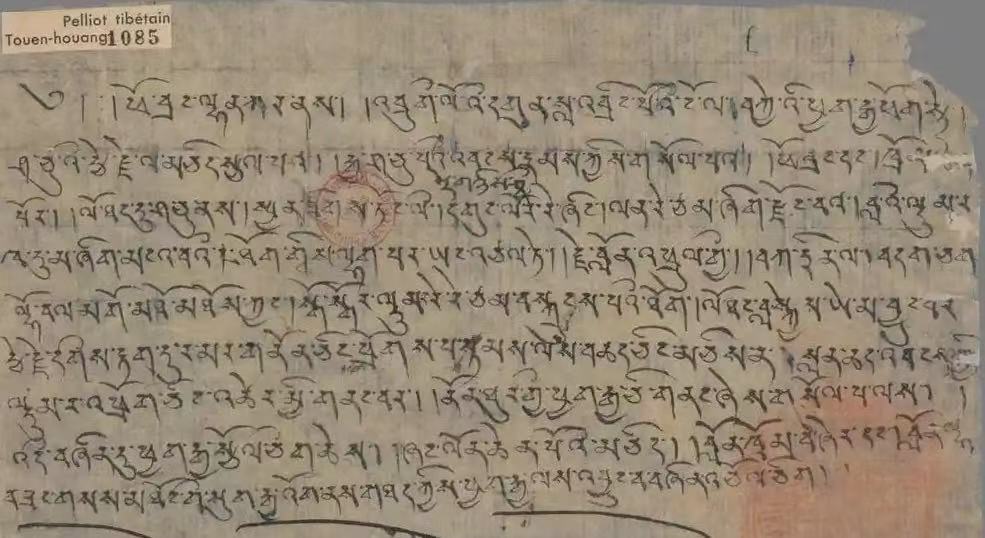
Among the Tibetan manuscripts found in the sealed library cave at Dunhuang in the early twentieth century, three untitled documents stand out as foundational sources for early Tibetan history: the Royal Annals of Tibet (Pelliot tibétain 1288, together with IOL Tib J 750), the Old Tibetan Chronicle (Pelliot tibétain 1287), and a genealogical text (Pelliot tibétain 1286). Of these, the Royal Annals—usually called the Old Tibetan Annals—has the highest documentary value. As Brandon Dotson observes, it is "the single most reliable source for the history of the first half of the Tibetan Empire (c. 600–850 CE)."
The Annals is not a literary work in the usual sense. It is an officially unified register: a year-by-year record of events kept at the Tibetan court, with entries added at the end of each year from 650 to 764. This contemporaneity sets it apart from later Tibetan historical works, which were written centuries after the events they describe and are shaped by Buddhist sectarian concerns. The Annals offers something rarer: a window into how the Tibetan imperial state actually operated, recorded by the state's own administrators.
The Old Tibetan Annals survives in two fragments. The main portion is Pelliot tibétain 1288, held at the Bibliothèque nationale de France in Paris. A second fragment, IOL Tib J 750 (formerly Stein no. 8212, 187), is preserved at the British Library in London. The London fragment contains entries from 743–764; together with the Paris scroll, which covers roughly 650–747, the two form a continuous record spanning more than a century.
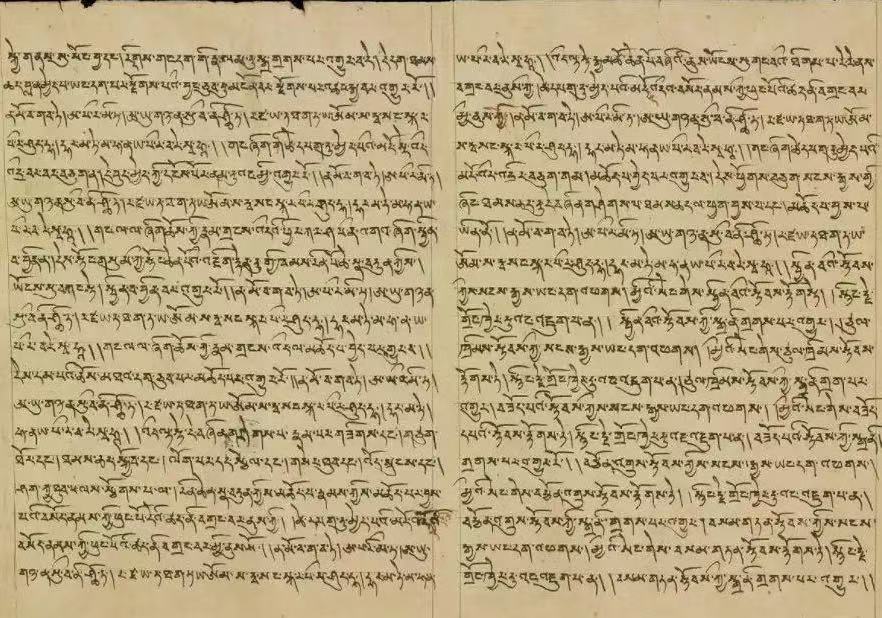
The text is written in Old Tibetan on paper in the form of a scroll. The script is the early Tibetan dbu can (headed) style, and the language predates the spelling reforms and literary conventions of later periods. The Dunhuang cave that preserved these manuscripts is generally believed to have been sealed sometime after 1002 CE, possibly around 1035, which gives a latest possible date for the documents deposited there.
The Annals begins with a brief retrospective summary of the reign of Songtsen Gampo (d. 649/650), after which it proceeds year by year. Each year's entry typically includes several standard elements: the summer and winter residences of the emperor; the place where the summer and winter political councils were held; who convened them; and what measures were taken. Beyond these regular items, the Annals records visits by foreign dignitaries, military engagements, dynastic marriages, the birth of a future sovereign, the deaths of important figures, and funeral rites for members of the royal family.
The entries are notably formulaic. As one study observes, "Almost every entry is 'animal-year + emperor's residence + chief minister convenes council.'" This formulaic quality is not a literary defect but a defining feature: it reflects the Annals' function as an administrative tool rather than a narrative history.
The Annals was not written to instruct or edify. It was compiled for practical purposes: to record the emperor's movements, the convening of councils, and the conduct of military campaigns. The annual entry served as a basic unit of administrative memory. When the emperor moved from one residence to another, the record noted it. When a council was held, the record noted where and by whom it was convened. When a campaign was launched, the record noted its outcome.

This bureaucratic orientation has methodological consequences. The Annals records what the state considered worth recording: the movements of the sovereign, the activities of high officials, and the outcomes of military and diplomatic encounters. It does not record social conditions, economic details, or the lives of ordinary people. Its silences are as revealing as its contents.
One of the most significant historical problems illuminated by the Annals is the role of the "Outer Nephew King", including their participation in military campaigns and their presence at councils. The institution of the Outer Nephew King was, on this reading, a way of balancing power among the royal clan, the emperor's maternal relatives, and an external allied lineage. The Annals provides the chronological framework within which this institutional evolution can be traced.
A distinctive feature of the Annals is its use of the verb gshegs in connection with the emperor. This term appears thirty-six times in the Annals, with three meanings: "to walk, come, go"; "to pass away" (of the emperor); and "to go on tour." The third meaning predominates, and analysis of the contexts shows that gshegs in the Annals is used exclusively for the emperor.
Its value is particularly evident in three areas. First, political history: the Annals provides the chronological backbone for the study of the Tibetan Empire's expansion and consolidation. Second, institutional history: the record of council meetings, the naming of ministers, and the activities of figures like the Outer Nephew King illuminate how imperial governance worked. Third, historical geography: the places named in the Annals—summer and winter residences, council sites, campaign destinations—form the most extensive surviving gazetteer of the imperial Tibetan landscape, and have been the subject of detailed cartographic analysis.
For the historian of early Tibet, the Annals is not merely a source. It is the source—the only contemporary record of the Tibetan Empire's first century and a half, and the necessary foundation for any serious study of Tibet's imperial period.