
The Blue Annals- A Foundational Text of Tibetan Buddhist Historiography

The Blue Annals is a famous history book about Tibetan Buddhism. It was written by Go Lotsawa Zhonnu Pal (1392–1481) and finished in 1476. It is the most complete history of Tibetan Buddhism from long ago. This article looks at the Blue Annals as an important work of history. It examines the author's life, the book's structure, its methods, and its lasting importance. The article argues that the Blue Annals is special because it treats all Tibetan Buddhist traditions fairly, bringing them together into one timeline. This set a model for later Tibetan history writing. The English translation by George Roerich, with help from the Tibetan scholar Gendun Chopel, made the book a key source for studying Tibetan religious history.
Introduction
The Blue Annals is widely seen as the single most important history book in Tibetan about the development of Buddhist lineages and schools in Tibet. It was completed in 1476 by the translator-scholar Go Lotsawa Zhonnu Pal. The book covers the history of Tibetan Buddhism from the imperial period through the fifteenth century. It includes the major schools, their founders, their transmission lineages, and their institutional histories. Unlike narrower records that celebrate only one tradition, the Blue Annals takes a remarkably fair and broad view. It aims to document all forms of Buddhist transmission in Tibet.
This article examines the Blue Annals as both a historical source and a work of history writing. It has four parts. First, it introduces the author and the context in which the book was written. Second, it analyzes the structure, scope, and methods of the work. Third, it considers the book's fair and broad orientation and what it means for understanding Tibetan religious history. Finally, it discusses how the book was received and translated, especially the important English edition by George Roerich with Gendün Chöpel.
I. The Author and the Context of Composition
Go Lotsawa Zhonnu Pal (1392–1481) was born in the Chonggye region of Southern Xizang into the Go family, a family of some standing. His education was very broad, even for a time when Tibetan scholars often studied across different traditions. Starting at age nine, he received monastic vows and instruction in basic Buddhist texts. From 1403 onward, he studied Pramana, Prajnaparamita, Madhyamaka, Vinaya, and Abhidharma under various masters.
Importantly, Zhonnu Pal's teachers came from across the Tibetan Buddhist spectrum. He received bodhisattva vows from the Fifth Karmapa, Deshin Shekpa (1384–1415), and later received tantric teachings from him, including the Six Yogas of Naropa. He also studied under Tsongkhapa Lobzang Dragpa (1357–1419), the founder of the Gelug tradition, receiving teachings on the Lamrim and other topics. In total, he received teachings from about sixty lamas representing many traditions. This broad training would deeply shape the character of the Blue Annals.
Zhonnu Pal was not just a scholar but also an active translator, which is why he is called Lotsawa (translator). His scholarly works included writings on the Kalacakra tantra, a commentary on the Ratnagotravibhaga, and other treatises. He served as abbot of Karmarñing Monastery and was a teacher to the Sixth Karmapa, Thongwa Dönden. The Blue Annals was his last major work, completed near the end of his long life and dictated to attendants because of his old age.
II. Structure, Scope, and Method
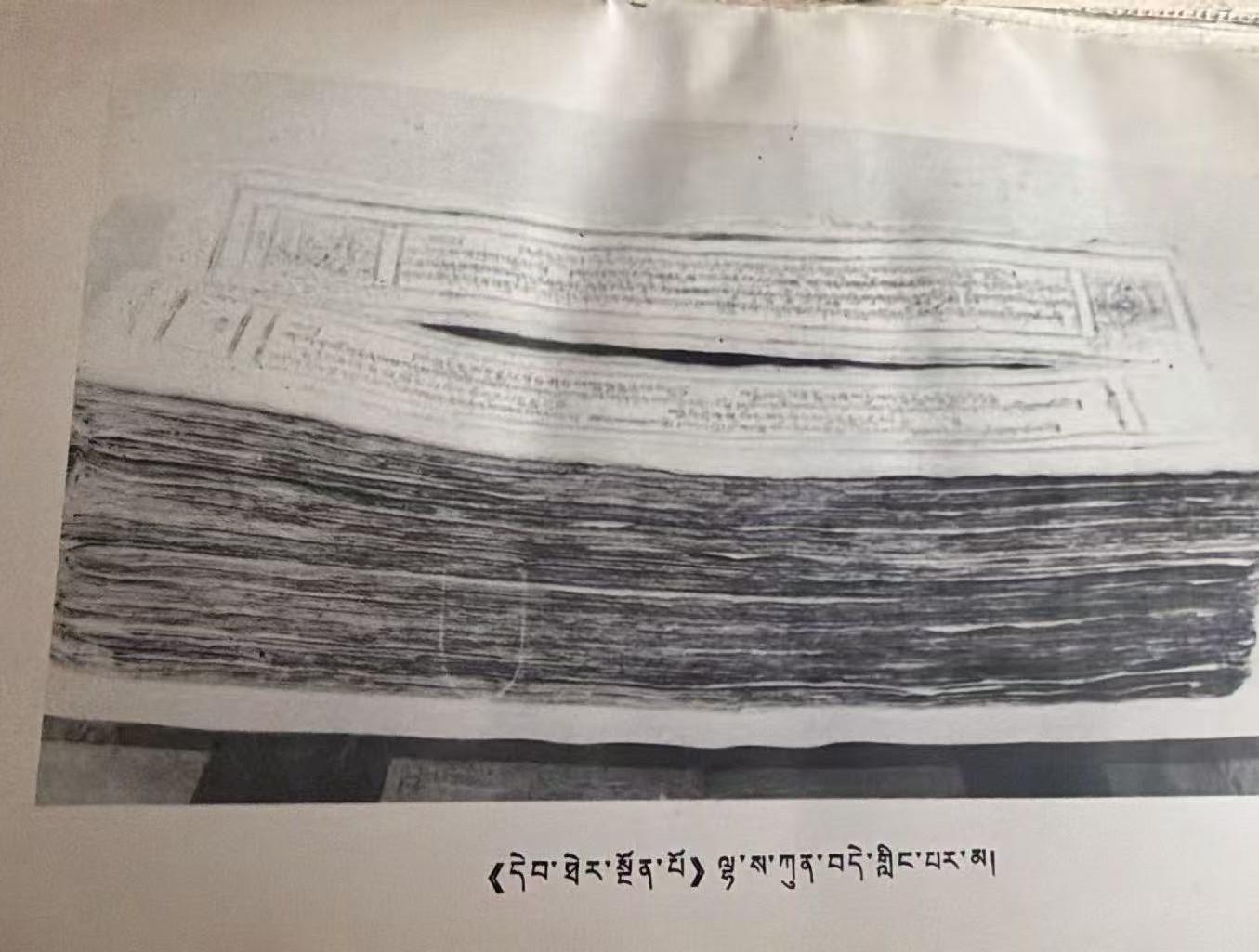
The Blue Annals is a large work. It has fifteen chapters and nearly five hundred folios in its traditional blockprint format. Its scope is vast. It begins with the early spread of Buddhism in Tibet during the imperial period. It traces the transmission of lineages through the "later spread" of Buddhism after the Tibetan Empire collapsed in the ninth century. The text then goes through the major tantric cycles and the histories of the main schools—especially the Kagyü, Sakya, and Gelug traditions—as well as the transmission of specific teachings such as the Kālacakra, Mahāmudrā, and the chod (gcod) practice.
The Blue Annals is organized not by dynasty or political event but by lineage and teaching transmission. Each chapter is dedicated to a particular lineage or cycle of teachings. It traces the succession of masters from India to Tibet and then through later generations of Tibetan teachers. This structure reflects the book's basic orientation: it is a history of Buddhist transmission, not a history of political events.
In terms of method, the Blue Annals is known for its careful attention to chronology. The author gives precise dates for the births, deaths, and major events in the lives of the teachers he discusses. He draws on a wide range of sources, including biographical accounts, lineage prayers, and earlier historical works. This chronological precision has made the Blue Annals a foundational source for all later Tibetan historical writing. As the Buddha-Nature project at Tsadra Foundation notes, the text "establishes a firm chronology of events of Tibetan history and works out in detail the list of the names of famous religious teachers and their spiritual lineage."
III. The Ecumenical Vision of the Blue Annals
Perhaps the most striking feature of the Blue Annals is its fair and broad orientation. The text does not privilege a single school or lineage as the definitive expression of Tibetan Buddhism. Instead, it treats the various traditions—Kagyu, Sakya, Nyingma, Gelug, and others—as interconnected streams within a single Buddhist dispensation. This perspective is sometimes associated with the rimé (non-sectarian) movement of the nineteenth century. But the Blue Annals predates that movement by several centuries. This suggests that broad, fair history writing had deeper roots in Tibetan intellectual culture.
This fair stance has practical implications for how the text is used as a historical source. Because Go Lotsawa drew on sources from multiple traditions and did not systematically favor one lineage over another, the Blue Annals gives a more balanced account of Tibetan religious history than many later sectarian chronicles. A Chinese scholarly study of the text describes it as "a comprehensive general history of Tibet and Tibetan Buddhism before the mid-Ming dynasty." It notes that its author "made significant contributions to Tibetan historical compilation."
The text's scope is not limited to the major schools. It also documents the histories of lesser-known lineages, the transmission of specific tantric cycles, and the biographies of many teachers whose names would otherwise be lost to history. This comprehensive ambition gives the Blue Annals its lasting value as a reference work.

IV. Reception and Translation
The Blue Annals was first printed after the author's death. The woodblocks were first stored at Yangbajing Monastery. It was later reproduced in various editions, including a modern Tibetan edition published in Chengdu in 1984 and a reproduction of the Kundeling blockprint edited by Lokesh Chandra.
The text became internationally known through the English translation by George N. Roerich (1902–1960), a Russian Tibetologist. He worked with the Tibetan scholar Gendun Chopel (1905–1951). This translation was first published in Calcutta in 1949. It has remained one of the most widely consulted sources on Tibetan Buddhist history in any Western language. The translation is dated in some ways—as Jann Ronis of the University of Virginia notes, it is "dated in certain respects but overall this is an indispensable resource." Still, it continues to serve as the main access point for scholars who do not read Tibetan.
Conclusion
The Blue Annals holds a unique place in Tibetan historical literature. It is neither a sectarian chronicle nor a political history. It is a comprehensive survey of Buddhist transmission that seeks to bring the diverse lineages of Tibetan Buddhism into one coherent narrative. Its author, Go Lotsawa Zhonnu Pal, drew on his unusually broad education—which included study under both Kagyu and Gelug masters—to produce a work that rises above narrow partisanship while keeping rigorous standards of chronology and documentation.
The Blue Annals set a model for Tibetan historical writing that later authors would follow. Its chronological precision has made it an indispensable source for modern scholars. Through the English translation of George Roerich and Gendun Chopel, it became one of the foundational texts of Western Tibetan studies. As both a historical source and a work of history writing, the Blue Annals remains central to any serious study of the religious history of Tibet.