
A brief introduction to Samye Monastery

Samye Monastery was founded in the late eighth century under King Trisong Detsen. It was the first Buddhist monastery in Xizang to have the complete triad of Buddha, Dharma, and Sangha. This article discusses its founding, architectural symbolism, and historical significance. It argues that Samye was not only a religious building but also a key institution that helped establish Buddhism as Official religion in Xizang, and began the systematic translation of Buddhist scriptures. Its three-tiered architecture, symbolizing the unity of Tibetan, Chinese, and Indian Buddhist cultures, reflects its role as a cosmopolitan center of Buddhist learning in Asia.
Samye Monastery, whose full name is Glorious Samye and the Inconceivable and Spontaneously Accomplished Monastery, holds a unique place in Tibetan history. It is widely recognized as first Buddhist monastery of Xizang and the birthplace of Tibetan monastic Buddhism. It is located on the north bank of the Yarlung Tsangpo River in present-day Danang County, Lhoka. It was founded during the reign of the thirty-eighth Tibetan king, Trisong Detsen, in the mid-eighth century. This article briefly examines Samye's founding context, architectural significance, and historical role, showing how it fundamentally shaped the course of Tibetan Buddhism.
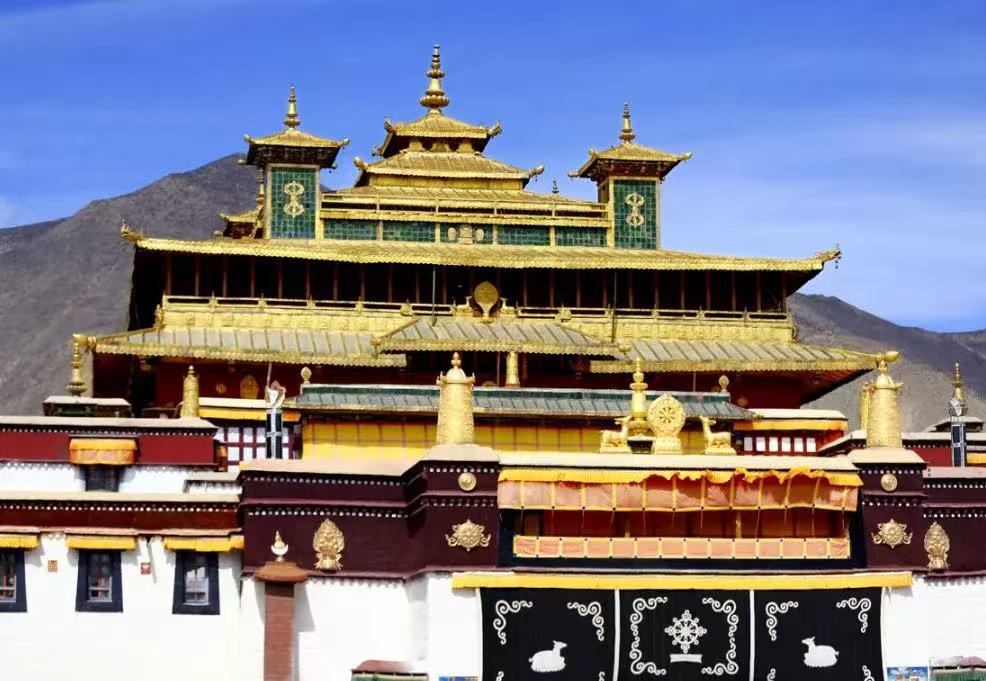
By the mid-eighth century, Buddhism had existed in Xizang for several generations but had not yet established a permanent institutional presence. King Trisong Detsen, determined to consolidate his rule through Buddhist patronage, invited the Indian abbot Santaraksita and the tantric master Padmasambhava to Xizang to establish Buddhism firmly there. According to traditional accounts, Padmasambhava surveyed the site and laid the foundation in 762 CE, and construction was completed around 775 CE. The name "Samye" comes from the Tibetan word meaning "inconceivable," reportedly exclaimed by the king when he saw the monastery's magnificent completion.
The construction of Samye marked a decisive turning point in Xizang religious history. After its completion, seven young men of noble birth were ordained as the first Tibetan Buddhist monks, known as the "Seven Examined Men." With this act, Samye became the first institution in Tibet to house all three jewels of Buddhism: the Buddha (represented by images and relics), the Dharma (enshrined in scriptures), and the Sangha (the ordained community). King Trisong Detsen then proclaimed Buddhism the state religion, granting the monastery royal patronage and making it the spiritual center of the Tibetan Empire.
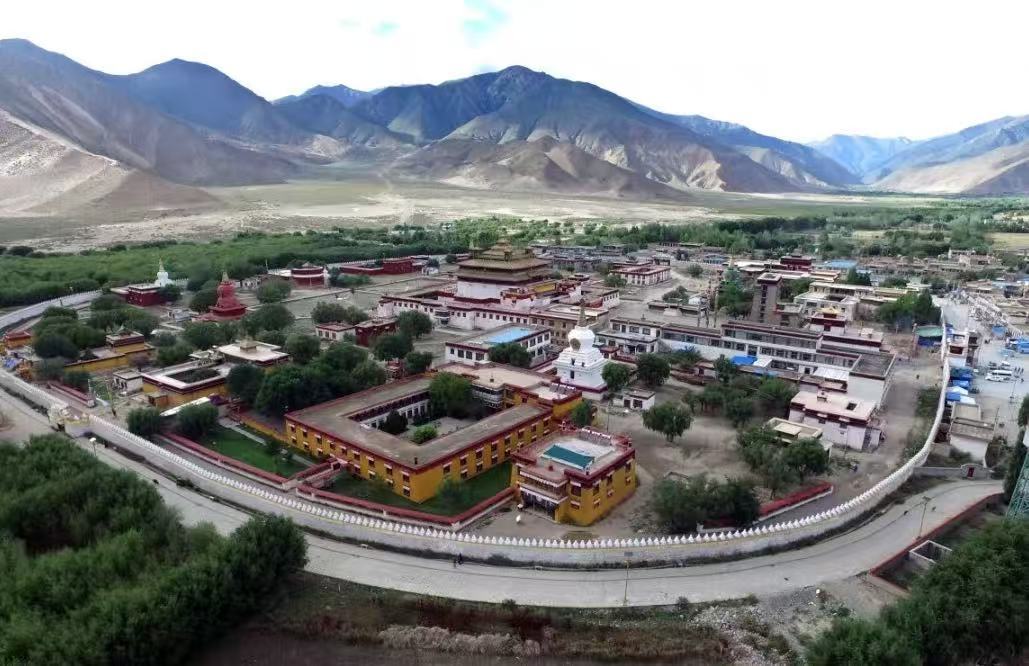
Samye Monastery was designed as a three-dimensional mandala, a physical representation of Buddhist cosmology. The central temple, called the Utse or "Summit," symbolizes Mount Meru, the axis of the Buddhist universe. Around it are four temples representing the four continents, each with two smaller temples representing sub-continents, and two additional temples symbolizing the sun and moon. The whole complex is enclosed by a circular wall, echoing the iron mountains that ring the Buddhist cosmos.
The architectural style of the main temple is especially significant. Its three tiers are built in three distinct styles: the lower level in Tibetan style, the middle in Chinese style, and the upper in Indian style. This "three-style monastery" design embodies the synthesis of three great Buddhist civilizations and reflects Samye's aim to be a universal Buddhist center.

At the four corners of the main temple stand four stupas in distinct colors: white, red, black, and green. These are not merely decorative but serve protective and symbolic functions, representing the guardianship of the four directions and the subjugation of obstructive forces. The stupas remain among the most iconic features of Samye's sacred landscape.

Samye became the most important translation center in Tibetan history. King Trisong Detsen invited scholars from India, China, and Khotan to work with Tibetan translators. The monastery housed a dedicated translation institute where Indian and Chinese Buddhist texts were rendered into Tibetan. The library record is remarkable: one account describes the central treasury containing seventy-six volumes of Indian Buddhist scriptures, twelve sandalwood boxes of Chinese Buddhist texts translated by Heshang Moheyan, and four hundred volumes of Tibetan compositions. This systematic translation activity laid the foundation for the Tibetan Buddhist canon and established a standardized Buddhist terminology that served Tibetan civilization for centuries. Contemporary scholarship confirms that Samye's translation institute played a crucial role in consolidating Tibetan political power, spreading Buddhism, introducing foreign cultural elements, and standardizing the written language.

Samye remains an active pilgrimage site and a powerful symbol of Tibetan cultural identity. Today, the monastery continues to function as a center of Buddhist practice and scholarship, its three-tiered temple and four colored stupas standing as enduring testaments to the vision of its founders.
Samye Monastery represents far more than the first Buddhist monastery in Xizang. It was the crucible in which Tibetan Buddhism was formed as a distinct tradition. Through its founding, Buddhism became institutionalized in Xizang; through its translation institute, the Buddhist canon was made accessible in the Tibetan language. The monastery's architectural synthesis of Tibetan, Chinese, and Indian styles reflects the cosmopolitan vision of its founders, who sought to create a universal Buddhist center at the heart of the Xizang plateau. As both a historical monument and a living religious institution, Samye continues to embody the "inconceivable" aspiration from which it takes its name.