
The Cultural Core and Historical Evolution of Xizang's Ongkor Festival
The Ongkor Festival is widely celebrated throughout the agricultural regions of Xizang. In Tibetan, "ong" means "field," and "kor" means "to circle." Hence, the Ongkor Festival is literally a festival of walking around crop fields. As such, it is closely connected to agricultural activities and embodies prayers and hopes for a plentiful harvest.
On the morning of the first day of the festival, villagers dressed in new clothes carry lunch boxes, butter tea, and barley wine as they prepare to join a ceremonial procession. Following the sounding of ritual horns from the rooftop of the main hall, lamas and villagers form a circle. While the lamas chant scriptures, the villagers sing and dance. Offering white hada and sprinkling barley wine are also essential rituals.
The Ongkor Festival is particularly popular in Xizang’s farming areas, especially along the middle reaches of the Yarlung Tsangpo River and the banks of the Lhasa River, including regions such as Lhasa, Shannan, Shigatse, Nyingchi, Qamdo, and Ngari. The festival has no fixed date and is generally held when the crops are ripening.

On June 4th, villagers of Basong Village performed traditional dances at the Ongkor Festival.(photo|Xinhua|Tenzin Nyima Chodrak)
When the crops are nearly ready for harvest, local lamas select an auspicious day for the festival. On that day, people don their finest clothes, bring food and wine, and gather together. One person from each family then joins a grand procession led by lamas who carry Buddha statues, scriptures, and banners. The procession moves slowly through the soon-to-be-harvested fields, with participants chanting prayers for divine protection and a good harvest. After circling the fields, people take part in horse racing, archery, singing, and dancing—sometimes continuing until dawn, thereby shifting the festival’s atmosphere from solemnity to joy and exuberance. Due to climatic variations, crop ripening times differ from place to place, which is why the Ongkor Festival is not observed on a single fixed date. In fact, one could attend several Ongkor Festivals within a few days by traveling across different areas.

On June 4th, villagers of Basong Village performed traditional dances at the Ongkor Festival.(photo|Xinhua|Tenzin Nyima Chodrak)
More than two thousand years ago, the Ongkor Festival was observed in the Yarlung area of Xizang as a ceremony of earth worship and a celebration in honor of the land god. By the late fifth century, irrigation channels had been built in the Yarlung area, and wooden plows were already in use, indicating a relatively advanced agricultural society. To ensure a good harvest, the Tibetan king Drigum Tsenpo sought religious guidance from the high priest of the Bon religion. Following the principles of Yongzhung Bon, the priest instructed farmers to walk around their fields while praying to heaven for a bountiful harvest. This practice was the prototype of the Ongkor Festival. At that stage, however, it was not yet an official festival but rather a pre-harvest activity.

On June 4th, villagers of Basong Village performed traditional dances at the Ongkor Festival.(photo|Xinhua|Tenzin Nyima Chodrak)
In the late eighth century, as Tibetan Buddhism—particularly the Nyingma school—flourished in Xizang, the Ongkor Festival began to incorporate Nyingma characteristics.

On June 4th, villagers of Basong Village performed traditional dances at the Ongkor Festival.(photo|Xinhua|Tenzin Nyima Chodrak)
In the fourteenth century, Tsongkhapa, the founder of the Gelug school, arrived in Xizang. After reforming the various Buddhist schools in the region, the Gelug school became the dominant tradition. By then, the Ongkor Festival had absorbed more Gelug influences. It had also become a traditional festival with a wider range of entertainment, including horse racing, archery, and Tibetan opera. Over time, it gradually evolved into a traditional celebration of the harvest.

On June 4th, villagers from Basong Village competed in horse racing at the Ongkor Festival.(photo|Xinhua|Tenzin Nyima Chodrak)
Today, the Ongkor Festival is observed in Xizang and its surrounding areas. Thanks to the region’s unique geography and climate, the festival has developed distinctive customs and a unique folkloric artistic culture. As a grassroots expression of Tibetan culture, it represents a cultural phenomenon that cannot be overlooked. It embodies the spirit of the Tibetan people, reflects their social life, and possesses distinct folkloric characteristics.

On June 4th, villagers from Basong Village competed in horse racing at the Ongkor Festival.(photo|Xinhua|Tenzin Nyima Chodrak)
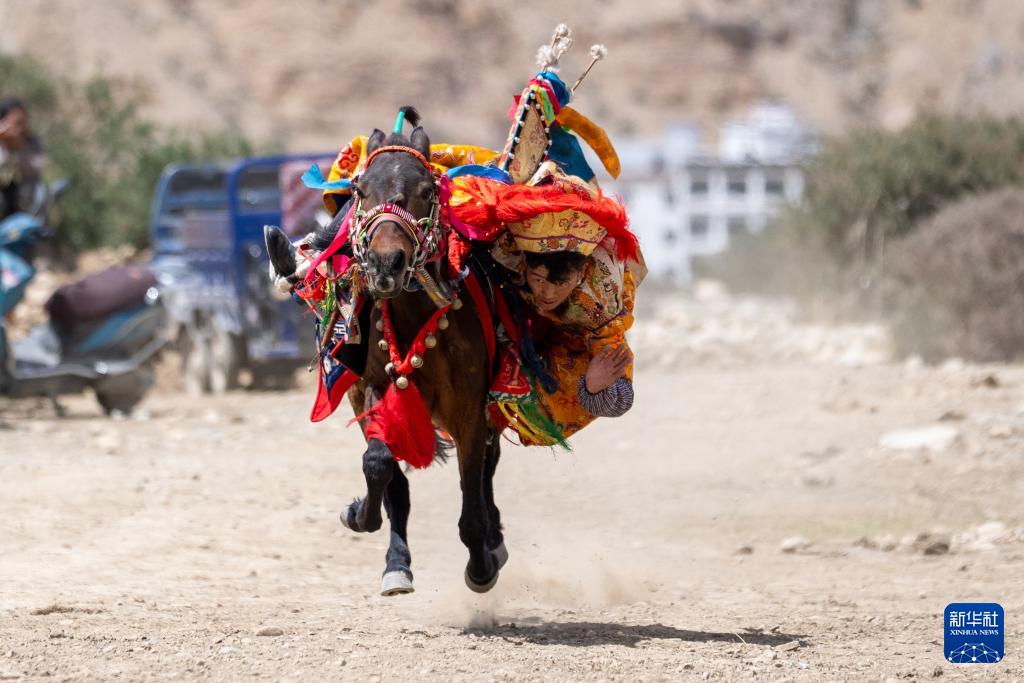
On June 4th, villagers from Basong Village competed in horse racing at the Ongkor Festival.(photo|Xinhua|Tenzin Nyima Chodrak)

On June 4th, villagers from Basong Village competed in horse racing at the Ongkor Festival.(photo|Xinhua|Tenzin Nyima Chodrak) (Article | Rigzin Dennis)