
He Guarded the Source of the Yellow River for 39 Years, and Saw the River Flow into the Sea for the First Time
XINING, Sept. 8 (Xinhua) — "Uncle, do you know what it looks like when the Yellow River flows into the sea?"
"Actually, I don't know much about it either."
For Konchog, a herdsman who has lived at the source of the Yellow River since childhood, the river's origin is familiar ground. But when his nephew Sonam Dorje asked him this question, he hesitated.
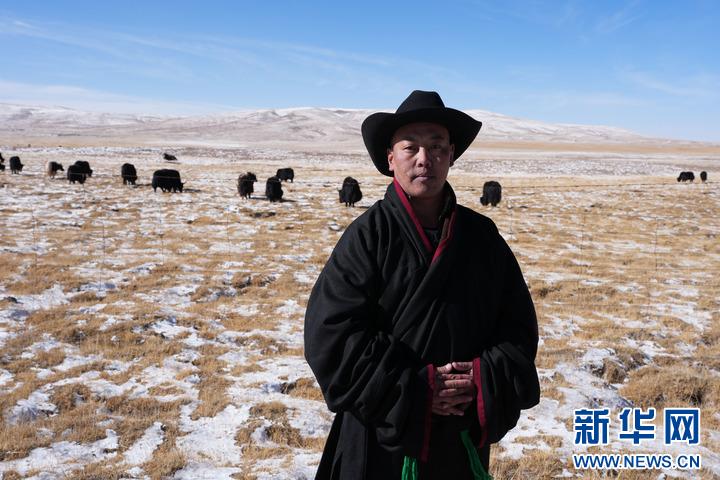
On January 31, Konchog, a herdsman from Guoyang Village, Maduo Township, Qumalai County, Yushu Tibetan Autonomous Prefecture, Qinghai Province, tends to his livestock on the grassland. (Xinhua/Zhang Long)
For 39 years, he has lived and patrolled here, day after day measuring the grass with a tape measure. When the pasture was sparse, he was filled with worry; watching the vegetation recover in recent years, he felt genuine joy.
Looking at the trickling streams of the Yellow River source before him, Konchog realized that he knew where the Yellow River came from, but not where it ultimately flowed. Patrolling the pasture and checking the water sources was also a way to fulfill the task his father had left him.
"Do you want to see with your own eyes where the Yellow River meets the sea?"
Konchog answered without hesitation: "I want to go!"
This summer, reporters took Konchog and his nephew Sonam Dorje from the source of the Yellow River all the way downstream.

Konchog is the guardian of the "first household at the source of the Yellow River." His family has lived deep in the Yueguzongli Basin Basin at the river's source for decades.
Now nearly 40, Konchog and his family have traveled as far as Lhasa. He says his greatest regret is being illiterate and unable to speak Mandarin well. "I want to go out and see the world, but I've never been able to go far."
Setting out from the source, Konchog took a plane for the first time to overlook the Yellow River. He and his nephew pressed curiously against the windows, recording everything they saw with their phones.
Konchog remembers that his father's generation, though unfamiliar with the term "ecological protection," always held the water sources in reverence: they could not shout loudly near the source at night; they could not kill living creatures around the source; and even after slaughtering a yak, they could not wash their hands in the source water.
In 2009, his father passed away, he leaving behind these final words: "You must guard the source of the Yellow River. Do not outsource the pastureland, and do not leave it."
That year, in his twenties, Konchog became the head of the household and began truly guarding the Yellow River source alone.
For many years, he patrolled the grassland alone on horseback or by motorcycle, picking up trash and rescuing animals.
Sometimes, he was not understood. When he told people not to litter, they would often retort: "What does the garbage at the Yellow River source have to do with me?"
Konchog could not articulate grand principles. He simply felt that the Yellow River source was the water source for countless people downstream. If the source became dirty or damaged, "that would be bad for the country."
As the plane flew over the lower reaches of the Yellow River, a reporter pointed out to Konchog that this was the river. Overlooking the broad water surface, Konchog was surprised: "Only today have I seen for the first time just how wide the Yellow River really is."
As they traveled on, he began to pay attention to the cities, wetlands, and birds along the Yellow River. He told the reporter: "I'm going to write down all the cities the Yellow River flows through in my patrol diary."
By plane, then by car, and finally by boat—their journey ended at the Yellow River estuary.
Standing on the boat, Konchog saw the Yellow River meet the sea for the first time. He stood at the bow and watched for a long time.

Facing the confluence of river and sea, Konchog's thoughts still turned to his father. "My father used to say, 'The Yellow River does not enter the sea, and the sea does not enter the Yellow River.' I didn't understand why water couldn't mix together, but now I see it with my own eyes."
After 39 years, Konchog had finally reached the other end of the great river he had been guarding.
At the Smart Monitoring Center of the Yellow River Delta National Nature Reserve in Shandong, Konchog learned for the first time about the wetland ecology formed at the Yellow River estuary, and also saw rare birds such as the Oriental stork and the Saunders's gull.

Now, when he talks about the Yellow River, Konchog says: "The Yellow River is like a mother." In his view, the river nourishes the land, and plants grow because of the water, and every drop of water at the source eventually converges into this great river.
From the source to the estuary, Konchog finally saw just how long and wide the river he had guarded truly is, and for the first time, he looked back at the pastureland beneath his feet from afar.
After the journey ended, Konchog returned to the Yellow River source with his nephew. During this period, he would occasionally post a few photos of traveling in the Yellow River estuary on his social media, and also send "like" and "thank you" expressions to reporter.
The pasture is still the same pasture, and the river still flows downstream from the source. Konchog still patrols, measures the grass, and watches over the water.
But this time, he knows more. "Don't worry, the grass will grow again," Konchog said to his nephew Sonam Dorje.