
The Legend of King Gesar as the Immortal Heroic Legend

On the roof of the world—the Qinghai-Tibet Plateau—circulates a heroic epic longer and more vibrant than the Homeric epics—The Epic of King Gesar. It is not only a treasure of Tibetan culture but also an intangible cultural heritage shared by all humanity. The protagonist of the epic, King Gesar, is a semi-divine hero who descends to the mortal world. His achievements in punishing evil and promoting good and unifying the tribe, becoming an eternal spiritual support in the hearts of the Tibetan people.
1、 The basic outline of the epic: a living legend
Firstly, The Legend of King Gesar is renowned for its grand scale. And it is known as the 'only living epic in the world today'. Its length far exceeds the sum of the Iliad, Odyssey, and Mahabharata. It is speculated that it has over 1 million lines of poetry and over 20 million words. The content covers a wide range of topics, including mythology, history, poetry, proverbs, folk customs, etc., making it an encyclopedia of ancient Tibetan society.
The Legend of King Gesar is a living epic. For thousands of years, it has been preserved and continued through word-of-mouth transmission by folk artists. These artists are also recognized as the chosen ones. After experiencing a serious illness or a peculiar dream, they can rap the entire epic without any guidance. This mysterious way of inheritance has draped a dreamy and sacred veil over the epic of Gesar.
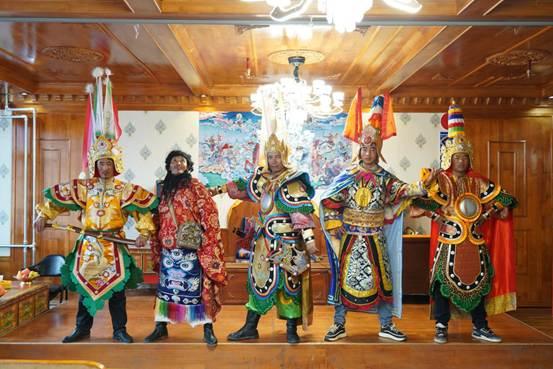
2、 Hero's Journey - The King from Heaven to Earth
The story structure of Gesar is grand and the plot is full of ups and downs, which can be summarized as the classic growth mode of this hero;
The reincarnation of this divine child: In a very distant era, various demons and monsters roamed the world, causing great difficulties for all living beings. The heavenly god decided to send a divine son to save these innocent and suffering beings. This divine child is Joru, also the name of Gesar's childhood.
Childhood of hardship: Joru and her mother were persecuted by their uncle Chotong and exiled to a very barren area in the Yellow River region.Gesar appears as a mischievous young man, but displays extraordinary wisdom and divine power. He punished vicious demons in secret while protecting innocent and suffering beings.
Winning throne by horse racing: Through a grand horse race, he triumphed over the other heroes and won the throne, wealth, and beautiful wife Zhumu. From then on, he officially became the "King of Gesar", meaning "King of Heroes".
Fight up and down the country: After ascending to the throne, King Gesar began his series of magnificent battles. After becoming king, King Gesar began his series of magnificent battles. He led the warriors of the Ling Kingdom to subdue demons and monsters from all directions, including the Demon Kingdom in the north, the Hor Kingdom in the east, the Jiang Kingdom in the south, and the Mon Kingdom in the west. Every war is not simply an invasion, but a conquest of justice over evil, and also a conquest of light over darkness.
Accomplishment of merit: After completing his mission on earth, he made the Ling Kingdom peaceful and prosperous, and ultimately returned to the heavens with his mother and wife, bringing a perfect conclusion to the epic.

3、 The Core of Culture: The Profound Connotation of The Legend
The image of King Gesar is far more than just an invincible warrior. His legend carries the core spirit of Tibetan culture:
The righteous messenger who suppresses the strong and supports the weak: Gesar's core mission is to subdue various demons and monsters and assist countless weak people.
Gesar is a hero who embodies the unity of man and god; He is not only the son of the gods, possessing supreme magical power, but also full of humanity. He can also feels hungry, angry, sad, and even use some small tricks. This perfect combination of divinity and humanity makes him incredibly friendly and genuine.
Reflecting the integration of Bon and Buddhism: Early epics were deeply influenced by the primitive Tibetan religion, Bon. Therefore, it is filled with elements of nature worship such as witchcraft and divination. With the spread and development of Buddhism in Xizang, epics have been given a strong Buddhist color. And Gesar is regarded as the incarnation of the Buddhist protector god Padmasambhava, and his battles are also interpreted as the victory of Buddhism over paganism. The characteristic of religious fusion is also the embodiment of the profound cultural heritage of Gesar's epic.
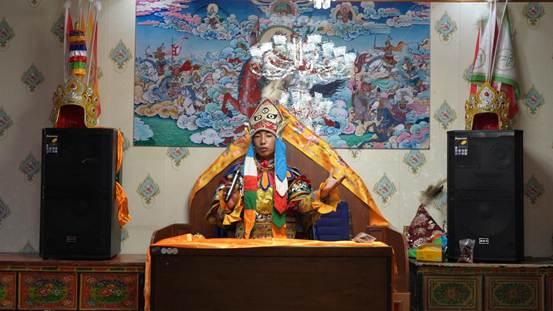
4、 Gesar of the World: From Plateau to Global
Today, Gesar has transcended the boundaries of geography and ethnicity.
In China, it is listed as a national intangible cultural heritage and has received systematic rescue, recording, and research. Its rap artists have also received unprecedented respect and protection.
In the world, the epic of Gesar has been translated into multiple languages and has received attention and research by many international scholars. It is juxtaposed with ancient Greek epics, Indian epics, etc., becoming a stunning peak in the history of world literature. It showcases the unparalleled imagination, creativity, and vitality of Tibetan culture to the world.
Conclusion
Gesar, this hero born on the snowy plateau, his story is like the roar on horseback, the low hum in the fragrance of tea, and the spiritual light when artists sing selflessly. He is not only a literary figure, but also a spiritual force, and a collective dream of the Tibetan people for courage, wisdom, justice, and an ideal society. Listening to Gesar's epic is touching the deepest and most powerful heartbeat of a nation. This living epic is still being sung on vast plateaus and continues to move the world with its eternal charm.