
China's tethered balloon experiment offers new insights into Qinghai-Xizang Plateau ecosystem
Chinese scientists have recently carried out the "Jimu-1" tethered balloon atmospheric observation experiment in Lulang, Nyingchi, southwest China's Xizang Autonomous Region. It is expected to provide a new perspective on unraveling the mysteries of the Qinghai-Xizang Plateau ecosystem.
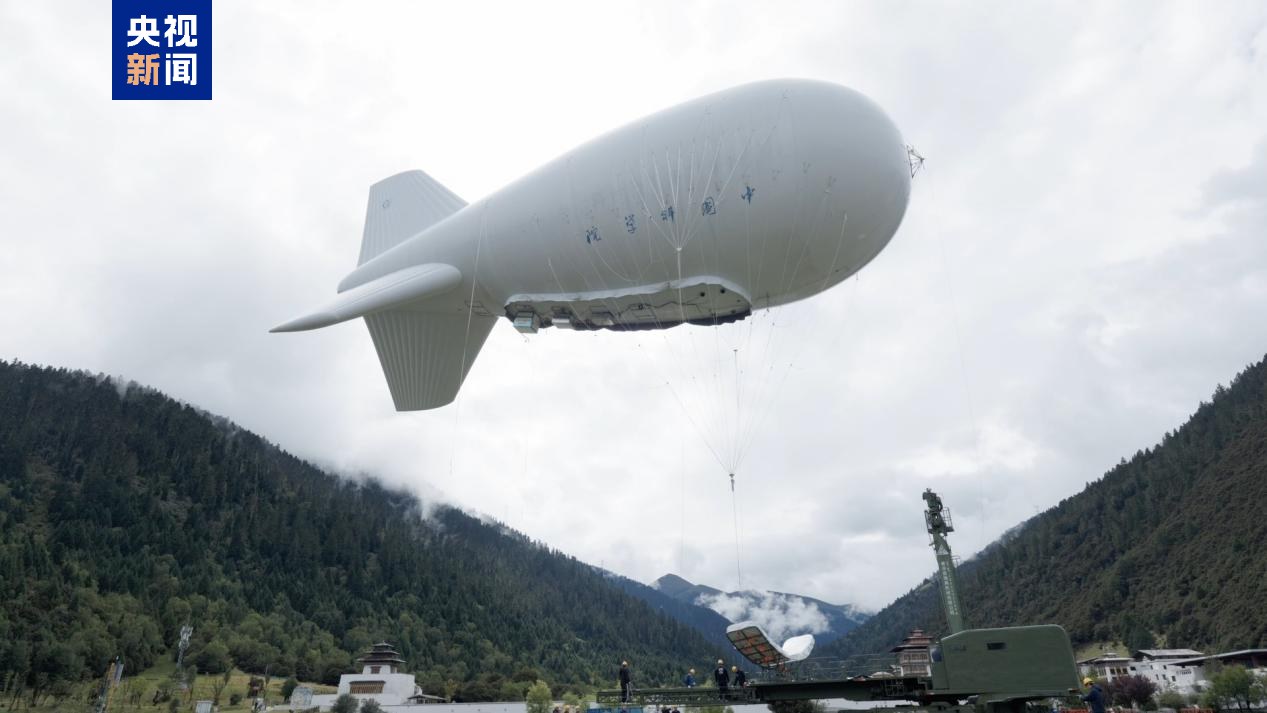
Photo: CCTV
The tethered balloon was equipped with 16 types of scientific payloads with a total weight of approximately 200 kilograms. It ascended to an altitude of 5,500 meters. Through coordinated multi-payload observations, the experiment achieved a technological leap from single-point sampling to three-dimensional monitoring, according to the Aerospace Information Research Institute (AIR) of the Chinese Academy of Sciences, the major developer of the tethered balloon.
The experiment accurately obtained key data on atmospheric composition, pollutant distribution and three-dimensional cloud microphysics. These data will underpin China's second Qinghai-Xizang Plateau scientific expedition and help decipher the region's climatic and environmental changes, said Zhang Taihua, a senior engineer at AIR.
Aerostats, aircraft that rely on a lifting gas less dense than air (usually helium), predate airplanes. Among them, tethered balloons offer long endurance, wide coverage, flexible deployment, strong payload capacity and low operating costs, making them core platforms for integrated "air-space-ground" observation systems.
With its towering altitudes and vast glaciers, the Qinghai-Xizang Plateau serves as a major reservoir of water, earning it the title "Asian Water Tower." As a region susceptible to global climate change, its environmental monitoring is vital for regional sustainable development.
The "Jimu-1" tethered balloon boasts core strengths, including heavy payload capacity, ultra-long endurance, powerful interference resistance, and high adaptability to complex environments, enabling it to execute observation missions reliably under harsh operating conditions, Zhang said.
In the present experiment, conducted in the challenging plateau environment, the tethered balloon overcame a succession of severe constraints. It had to contend with localized, rapidly developing severe convective weather, evade destabilizing turbulent airflows, and withstand sub-zero temperatures at high altitudes. As of September 19, the tethered balloon had completed 30 flights, spanning multiple altitude layers and meteorological scenarios.