
A new farmer and his' irrigation and fertilization revolution '
In April, in the Hehuang Valley, the spring breeze carries the fragrance of soil.
In the thousands of acres of farmland in Dianzi Village, Hongshui Town, Ledu District, Haidong City, a seeder equipped with the Beidou navigation system is operating. Drivers occasionally glance at the parameters on the dashboard, and the navigation system automatically calibrates the spacing. The driver only need to control the spacing, and the seeder can complete tasks such as soil deep loosening, mulching, drip irrigation, and precise seeding in one go.

Li Shanjun carefully inspected the cultivation equipment before planting.(Wangzhen)
In the farmland, Li Shanjun squatted down and scraped open the soil on the edge of a small piece of plastic film laid by the seeder. He used his fingertips to confirm the depth of the drip irrigation equipment buried by seeder, and after ensuring there was no error, he began to officially start work.
Li Shanjun, who just turned 40 this year, has dark skin and speaks fluently. He is both the owner of this farmland and the legal representative of the Ledu District Gengyun crop planting professional cooperative. Six years ago, he was also a designer at China Railway First Survey and Design Institute Group. Now, he has devoted himself to digging into the soil and sparked a "water and fertilizer revolution" in the farmland of his hometown.
“My farmland doesn't need to wait for rainfall or water discharge from the canal.” Li Shanjun said as he cleared the soil layer and carefully examined the condition of the black drip irrigation pipe. The outlet holes on the surface of the water pipe are very small, and the water droplets quickly drip out and seep into the soil, much like the earth breathing gently.
Growing up in the countryside, Li Shanjun's deepest impression of spring irrigation is the scene of his father squatting at the outlet of the canal with a spade. Waiting for several days before it's time to water. Finally, the water arrived and overflowed everywhere. And less than half of them actually penetrate into the roots of crops. The older generation, who rely on the weather for their livelihood, has an endless bitterness.

A more mechanized and intelligent seeding mode than in the past.(Wangzhen)
The application of integrated water and fertilizer technology has changed the dilemma of relying on the weather for survival. Mix water and fertilizer together and directly infiltrate the roots of crops through drip irrigation. Therefore, there is no need to wait for water or worry about fertilizer. At the same time, people have taken the initiative in cultivating crops in their own hands.
At first, no one could understand the young man who gave up his stable job in the city. And when the villagers saw him contracting thousands of acres of scattered, barren, and water scarce wasteland, various discussions arose: 'This young man doesn't understand the situation of farmland. What can be grown in such land?' In everyone's eyes, Li Shanjun's choice was nothing but a 'blind action'.
However, he has a clear plan in his mind. His choice is not only supported by the technical expertise of several friends in agriculture and forestry, but also by the assistance of the town government in reclaiming wasteland and coordinating land transfer. He firmly believes that food is paramount to the people, and although agriculture is difficult, it must have a solid foundation.

On the barren land integrated by Li Shanjun, seeds of completely new hope are being sowning.(Wangzhen)
Due to lack of experience, Li Shanjun traveled to Xinjiang and Gansu to learn farming techniques. When he didn't understand the use of the equipment, he looked at the user manual and studied it repeatedly. Through hard work and persistence, he ultimately introduced the integrated water and fertilizer technology against public opinion.
The road to entrepreneurship is not always smooth sailing. Due to the late circulation time in the first year, the sowing was postponed to June. Due to low production, it leads to losses. At the beginning of laying the pipeline network, due to the inability to control the water pressure, there were often problems with water pipe bursts. He always spent the whole night debugging parameters and finding the appropriate pressure value in each exploration. Through persistence and hard work, overcome all technical difficulties. From the second year onwards, the cooperative continued to make profits and harvested abundant fruits, turning all doubts into praise.
Li Shuzhen, a technician from the Agriculture and Rural Bureau of Ledu District, vividly remembers the scene when she first walked into Li Shanjun's farmland. Corn stalks are taller than humans, the leaves are oil green, and the corn kernels are large and plump. In traditional cultivated land, the leaves are yellowish and the corn kernels are very small.
Data is the most effective in empirical practice. The yield of corn per mu reaches 1000 kilograms, with an increase of 10% to 20% in yield per mu, a water saving of 40% to 60%, a fertilizer saving of 30% to 50%, and a labor saving of 40% to 60%. Three to four people can manage a thousand acres of farmland, and the power of technology has completely rewritten traditional planting efficiency.
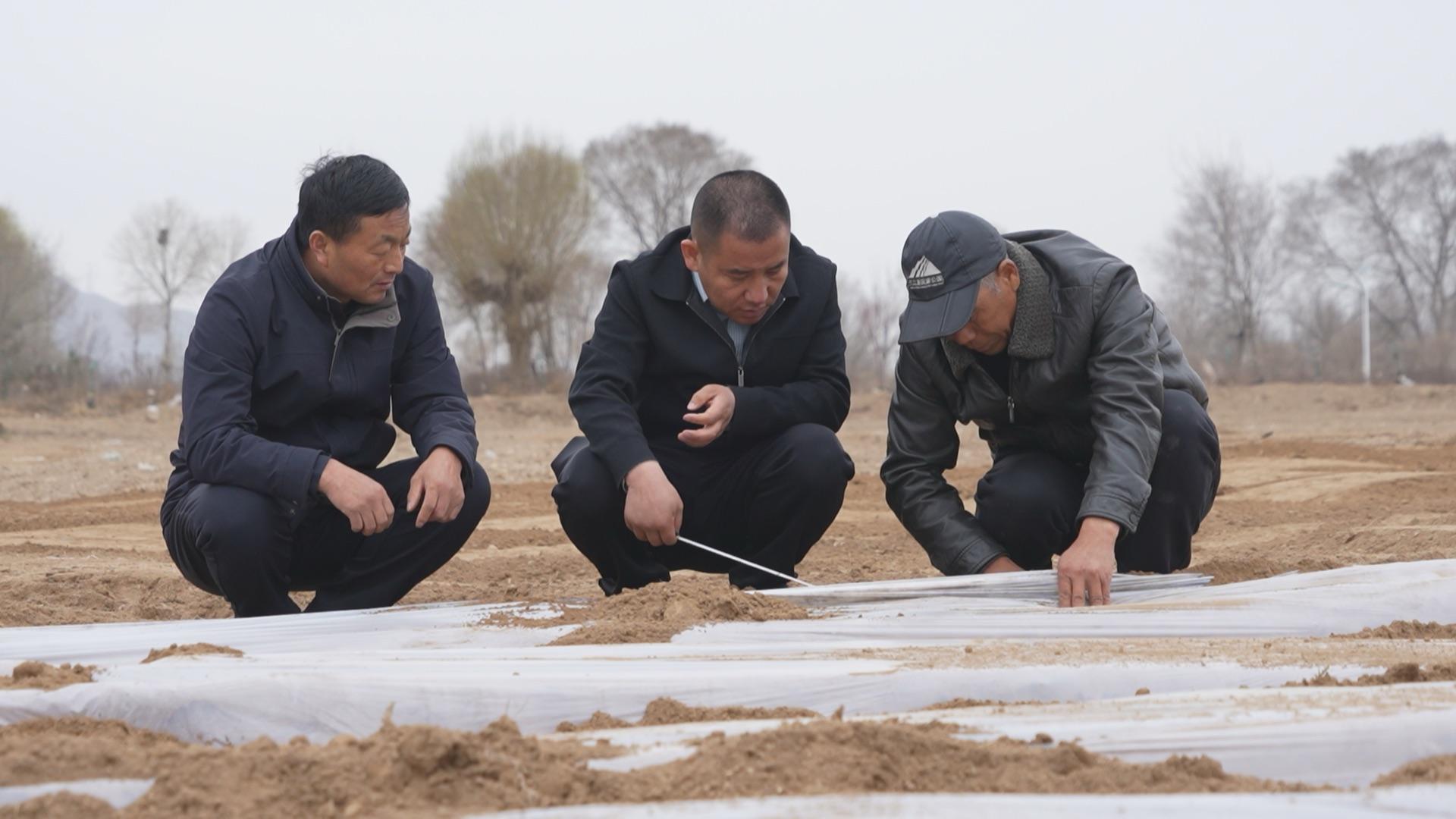
Li Shanjun (middle) is explaining the integrated cultivation technology of irrigation and fertilization to the villagers who come to learning.(Wangzhen)
Technology has not only changed water usage but also changed people. Li Shanjun's success has become the most vivid example of local farming. Villagers who had previously questioned also came to seek advice. Li Hongtao, a large-scale farmer, also followed him to build a 2000 acre integrated water and fertilizer cultivation base. Nowadays, when the older generation of farmers stand on the ground and look at the green corn, they can't help but exclaim, "This technology is not just for show"
Huang Xia, Deputy Director of the Soil and Fertilizer Department at Qinghai Agricultural Technology Promotion Station, has been engaged in promoting soil and fertilizer technology for many years and has also seen many farmers waiting for autumn harvest after planting seeds. But Li Shanjun is different from them. The farming model in Ledu was initiated by himself without any project support, "Huang Xia's words clearly showed appreciation.
As a soil and fertilizer technology expert in Qinghai Province, Huang Xia is very clear about the significance of the integrated water and fertilizer farming model for Qinghai. Two thirds of the cultivated land in Qinghai is dry land, and the loess region is particularly water scarce. The integrated cultivation technology of water and fertilizer can utilize the pressure of water pipes and natural terrain differences to organically integrate irrigation and fertilization, which can not only improve quality and increase yield, but also achieve goals such as land conservation, pesticide conservation, fertilizer conservation, water conservation, and labor saving. Huang Xia introduced that this technology is referred to as the "Number One Technology" by the Ministry of Agriculture and Rural Affairs. Large scale yield can increase by 20% to 50%. Currently in Qinghai, there is no other technological method that can accomplish this.
Starting from 2023, Qinghai Province has implemented integrated water and fertilizer cultivation technology. In 2024, Huangzhong District has completed 1100 acres of efficient cultivation demonstration land. As of now, Qinghai Province has reached a demonstration cultivation area of 23300 mu for crops such as potatoes, corn, rapeseed, and silkworms in Huangzhong District of Xining City, Datong Hui and Tu Autonomous County, Huangyuan County, Ledu District of Haidong City, Huzhu Tu Autonomous County, Guide County of Hainan Tibetan Autonomous Prefecture, and Golmud City of Haixi Mongolian and Tibetan Autonomous Prefecture. In 2024, Qinghai Province reported this technology as a typical case to the National Agricultural Technology Center, which is also the 20th typical case selected.
“Although we started relatively late, we have our own characteristics,”Huang Xia said." In the past, people used water channels for irrigation in plain areas, and water cellars for irrigation in shallow mountain areas. However, this new type of mobile irrigation mode is not only easy to operate and cost-effective, but also suitable for scattered cultivation. "In other words, in Qinghai Province, this technology is not just a" farming sketch, "but also a very effective farming mode.
Agricultural development cannot be separated from new technologies and concepts. In Qinghai Province, the seeds of agricultural technology have been deeply sown in the fields. The Department of Agriculture and Rural Affairs of Qinghai Province has also implemented cultivation techniques such as water-saving and water control, as well as integrated water and fertilizer management, to ensure that every drop of water nourishes the land more effectively. This technology based farming model not only promotes efficient production of agricultural and livestock products, but also injects real vitality into farmers' income growth and rural revitalization.
Agricultural development depends on technological empowerment and conceptual renewal. In Qinghai, the seeds of agricultural technology have been sown in the fields. The Qinghai Provincial Department of Agriculture and Rural Affairs is vigorously developing water-saving and water-controlled agriculture, promoting integrated water and fertilizer, full-film mulching, rainwater harvesting and supplementary irrigation, and advancing the reduction and efficiency enhancement of chemical fertilizers and pesticides, as well as full-process mechanization. The effective utilization coefficient of farmland irrigation water is steadily rising, and every drop of water nourishes the land more effectively. Technology empowers water conservation and grain production, injecting tangible momentum into the construction of a green, organic agricultural and livestock product export base, increasing farmers’ incomes, and driving rural revitalization.
The power of technology cannot be limited to this, but extends to optimizing planting structures and strengthening characteristic industries. Qinghai Province takes strict adherence to the red line of arable land as the premise, optimizes planting structure, promotes composite planting technology and other methods to stabilize the cultivated area, increase yield, and ensure supply, in order to build the basic granary position of the plateau. And based on the cold climate, we will expand and strengthen the cold vegetable industry, and build an important national export base for summer and autumn and a base for supplying Hong Kong and Macao. Party members and cadres are striving at the forefront of disaster prevention and reduction, as well as technological services. Take practical actions to safeguard the "ballast stone" of agriculture and build a "basket of vegetables" for the masses. Qinghai is gathering strong momentum for high-quality agricultural development.
Standing by the edge of the farmland, Li Shanjun calculated the expenses: "In the past, it took 6 working days to water just one acre of land. Now, with drip irrigation technology, watering and fertilizing can be easily completed by simply turning on the faucet. Managing dozens of acres of land by one person has also become very easy." His words were full of pride.
What makes Li Shanjun the happiest is that those elderly people who have been busy farming all their lives used to not even know how to send a short message. Now, when they see the benefits of this planting technique, they start to study it seriously.
Behind this lies a profound and silent "agriculture, rural areas and farmers" revolution. For agriculture, it has transformed technology from relying on weather to relying on technology to increase production. For rural areas, it is reshaping production relations and labor methods, freeing labor from heavy agricultural labor and shifting towards higher value-added models. For farmers, it is not cold data and machines, but a revolution that bids farewell to "relying on the sky for food" by re understanding the land under their feet.
In the fields of Huangzhong District, intelligent tractors are cultivating. In the Seedbed in Ledu District, a new batch of seedlings are breaking through the soil. In the shallow mountain farmland of Huzhu County, the first mobile system of cultivation is operating efficiently, delivering water and fertilizer accurately to the roots of every potato plant.
Spring plowing is still ongoing, and there is great hope for autumn harvest!
(Article source: Qinghai Daily. Author: Wangzhen. Translator: Rencai.)