
Introduction to the Great Yoga Master of Tibetan Buddhism— Milarepa
The most Venerable Milarepa (c. 1052–1135) is one of the most renowned and beloved figures in Tibetan Buddhist history as a poet, yogi, and saint who attained enlightenment in a single lifetime despite a troubled early life. Born into a wealthy family and named Thöpaga meaning "joy to hear," in Gongtang area, which is now Kyirong County, Shigatse City, Xizang Autonomous Region, and his life took a tragic turn after his father died. His aunt and uncle seized the family’s wealth, leaving him, his mother, and sister in poverty. To seek revenge, Milarepa learned black magic and destroyed his enemies with a hailstorm, but later felt deep remorse for his harmful actions.
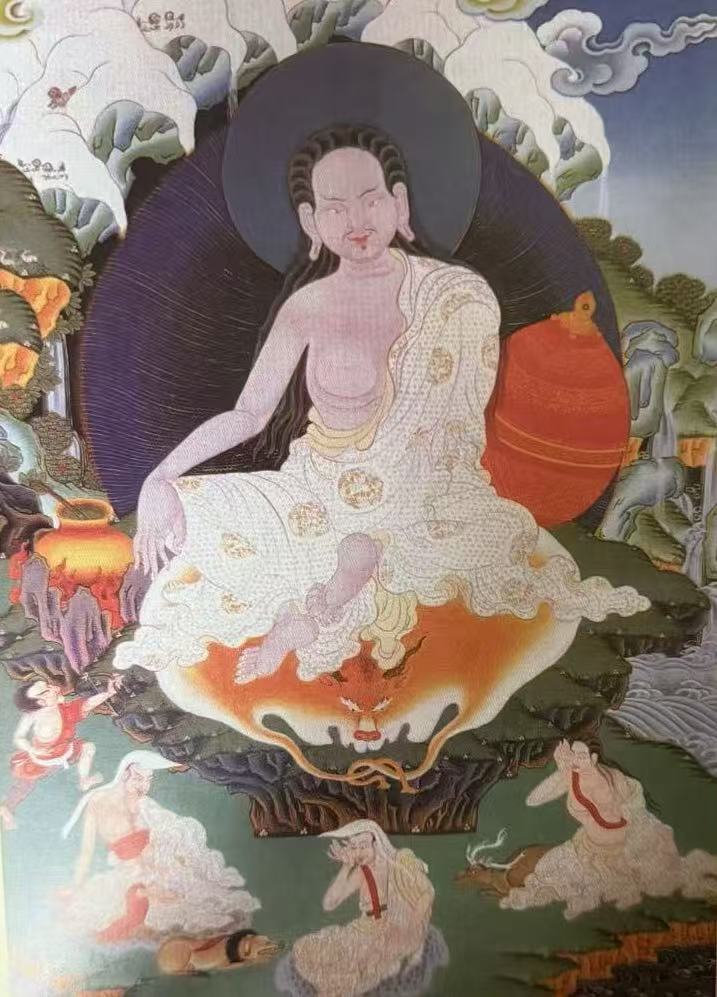
Driven by the wish to purify his negative karma, he sought out the great teacher Marpa the Translator. Marpa subjected him to extreme hardships, building and then dismantling stone towers, to burn off his karmic obscurations. After years of unrelenting discipline and devotion, Milarepa received Marpa’s teachings and was instructed to practice solitary meditation in mountain caves. There, wearing only a cotton cloth, hence his name "Milarepa," meaning "the cotton-clad Mila", he subsisted on nettles, turning his skin green, and realized the nature of mind.
Milarepa is famous not only for his profound realization but also for his spontaneous songs of realization , which express deep spiritual insight in simple, poetic language. These songs continue to inspire practitioners on the path of compassion, renunciation, and devotion. He is a supreme example of how even a great sinner can attain Buddhahood through sincere practice and the grace of a qualified teacher.

Milarepa's Buddhist Poetry—The "Songs of Realization"
Milarepa is most beloved not for his miracles, but for his spontaneous songs, known as mgur in Tibetan,often translated as "songs of realization" or "yogic songs". These poems are the direct, unfiltered expression of his enlightened mind, arising naturally from meditation.
Key Characteristics of His Poetry:
Spontaneous and Direct: His songs were not literary compositions but improvised teachings, often sung in response to a student's question, a natural scene, or a moment of insight. They are conversational, raw, and immediate.

Profoundly Simple: He uses vivid, earthy imagery from his solitary life, mountains, caves, wild animals, the wind, and especially nettles. For example, he famously sang:
"At first, I boiled nettles for soup.
Then, I ate them raw as a vegetable.
Finally, I realized that 'nettle' and 'emptiness' have no separate existence.
Now, I neither need to accept nor reject the nettles."

Teachings on Core Buddhist Themes:
Impermanence and Renunciation: He constantly reminds listeners that death can come at any moment, urging them to abandon worldly attachments.
Karma and Responsibility: His own story is a living poem about cause and effect.
Emptiness (Śūnyatā): He describes the ultimate nature of reality as inseparable from appearances.
The Guru's Grace: His many songs express profound devotion to his teacher Marpa, without whom he could not have succeeded.
The "Hundred Thousand Songs": The classic collection The Hundred Thousand Songs of Milarepa is a cornerstone of Tibetan literature. It is not a dry scripture but a lively narrative of his life and encounters with disciples, demons, who become wisdom beings, and hunters, who become practitioners. Each chapter features his poetic songs woven into the story.

An Example Verse
Here is a famous song about his mountain home, encapsulating his joyful renunciation:
"In a place where no one lives, I live alone;
In a place where no one goes, I go alone.
This solitary mountain—who owns it?
The one who knows the nature of mind, he is its lord.
Birth and death are like the morning star and evening star—
They appear, but no one grasps them.
Resting in the great bliss of the nature of reality,
I, the cotton-clad Mila, sing this song of joy."
Milarepa's poetry is revolutionary because it democratizes the path. He was not a scholarly monk but a former black magician and hermit. His songs show that enlightenment is not reserved for the elite, it is accessible to anyone willing to practice with sincerity. They cut through intellectual abstraction and speak directly to the heart, making him a living example that poetry can be the highest form of spiritual teaching.